Mobile WaterTreatment Trailer Unit 1500 CCW
Mobile surface water treatment unit · max. 1,500 l/h
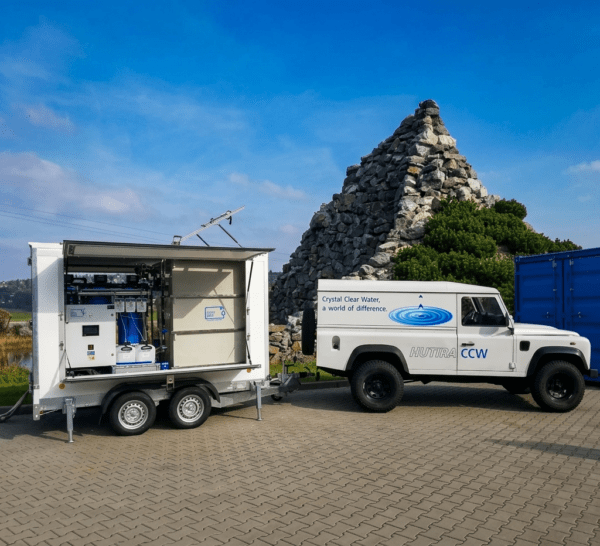
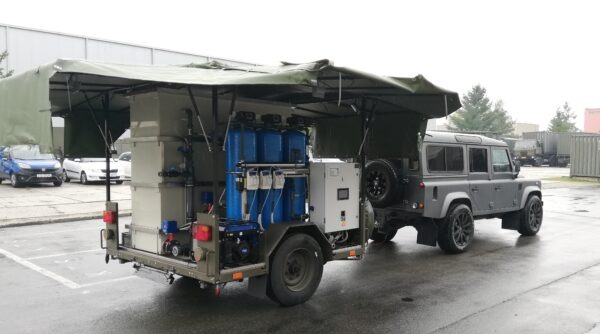
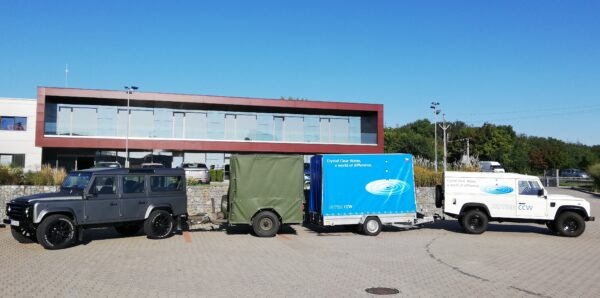
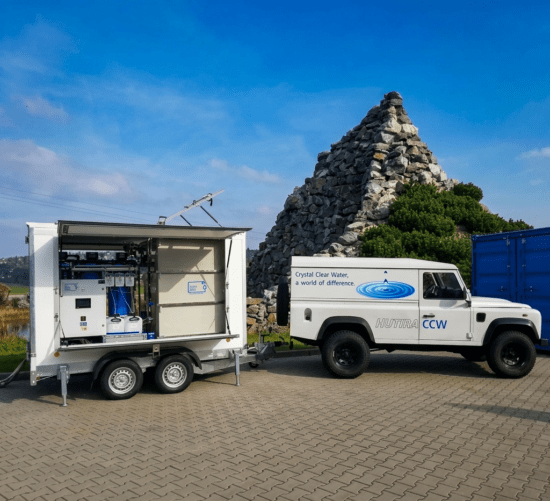
HUTIRA MOBILE WATERTREATMENT TRAILER UNIT 1500 CCW is designed for comprehensive treatment of surface fresh water. The technology is designed as a robust, universal, operationally flexible and independent (off grid) solution suitable for both temporary emergency and long-term deployment and long-term operation, suppling local water infrastructure.
Basic purpose/field of use: supplying the population with drinking water in the event of a failure of the public water supply system.
Possible sources of water for treatment: raw water from most surface sources (rivers, lakes, ponds) and partly also groundwater.
APPLIED TECHNOLOGY
- Raw water pumping
- Pre-treatment
-
- Physico-chemical clarification and sedimentation
-
- pH adjustment by chemical dosing
- Oxidation – sodium hypochlorite (NaClO) dosing
- Multistage parallel automatic pressure filtration (PYRO media, activated carbon)
- UV disinfection
- Final sodium hypochlorite (NaClO) dosing
- Advanced automation, control & remote monitoring
TECHNICAL PARAMETERS
| PARAMETER | VALUE |
| Maximum water aoutput | 1,500 l/h |
| Maximum daily production | approx. 33m3 |
| Operating time | up to 20 hours per day |
| Trailet dimensions (L x W x H) | L 4,200 x W 2,040 x H 2,430 mm |
| Total Weight | approx. 2 t |
| Outlet pressure | 1 – 3 bar |
| Installed electrical power input | 3 kW |
| Population supplied (5 l/person/day) | approx. 6,500 persons |
Water treatment process
First water treatment stage
Raw water is pumped into the clarifier, where the clarification process takes place. Before the clarification, chemicals are dosed into the raw water to adjust pH. The pH value has a significant effect on the chemical processes that occur in the individual stages of water treatment. The technology automatically analyses and adjusts the pH. Clarification is a key physico-chemical process in converting raw water into drinking water, based on coagulation and flocculation. A coagulant (aluminium or iron salts) is dosed into the raw water to neutralise the electrical charge of colloidal particles and destabilise them. Under controlled mixing, the particles agglomerate into larger flocs, which are then removed by sedimentation and filtration in the subsequent stage of the water treatment technology. The clarification process significantly reduces turbidity, the content of organic substances, and part of the microbial contamination, and prepares the water for further treatment stages. The first stage of slurry separation contributes significantly to the quality of treated water and the economy of operation.
Second water treatment stage
Sodium hypochlorite (NaClO) is dosed for disinfection and oxidation of iron (Fe) and manganese (Mn). The water then passes through three automatic pressure filters connected in parallel, removing fine mechanical contaminants and capturing Fe and Mn. Activated carbon filters remove excess chlorine, hydrogen sulphide, colour, oil substances, odour, chlorinated hydrocarbons, DDT, benzene, toluene, xylene, pesticides, humic substances, and trihalomethanes. The organoleptic properties of the water are improved in the final step.
Hygienic water security
The final treatment step uses UV disinfection to inactivate pathogenic microorganisms by damaging their DNA, without adding chemicals. A controlled dose of sodium hypochlorite (NaClO) is applied at the outlet to maintain microbiological safety during storage and distribution. The dosage is adjusted to flow rate and retention time to ensure effective disinfection while minimising undesired by-products.
Automation, control & remote monitoring
The water treatment system is operated via an advanced automation platform with remote monitoring capabilities, providing full operational control and real-time supervision of key processes, including water flows, process-chemical status, and energy consumption. The system can be switched to service mode for manual operation of individual stages. Accurate measurement and control support performance optimisation, rapid response to failures, and reduction of long-term operating costs.
RANGE OF TREATABLE CONTAMINANTION
| Parameter / Substance | Max. permissible limit in raw water | Unit |
| pH | 6.5 – 8.5 | / |
| Colony counts 22 °C | < 1,000 | cfu/ml |
| Colony counts 37 °C | < 1,000 | cfu/ml |
| Coliform bacteria | < 1,000 | cfu/100 ml |
| Escherichia coli | < 500 | cfu/100 ml |
| Turbidity | < 1,000 | NTU |
| Colour | < 1,500 | Hz |
| Total suspended solids (TSS) | < 1,500 | mg/l |
| Total dissolved solids (TDS) | < 500 | mg/l |
| Iron (Fe) | < 3 | mg/l |
| Manganese (Mn) | < 0.4 | mg/l |
Write to us
We wouldn’t be here without you. If you have any questions or feedback, don’t hesitate to get in touch.