WaterCat 2000 S (Simple)
Containerized Groundwater Teratment Units · Simple · 10 ft container · max. 2,000 l/h · off-grid (photovoltaic)
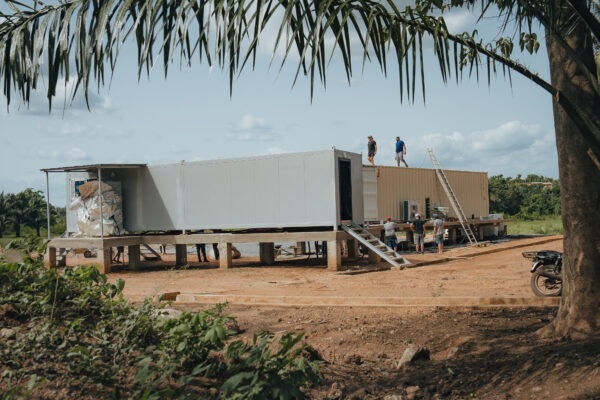
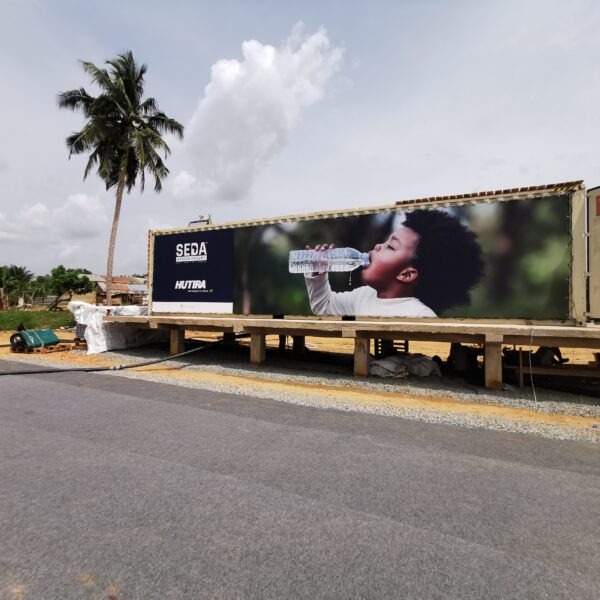
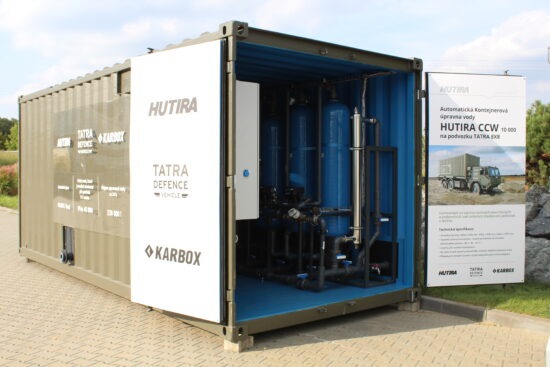
WaterCat 2000 S (simple) is a mobile containerized water treatment unit designed for the treatment of groundwater. The technology is designed as a maximally simple, compact, autonomous, and energy‑efficient, independent (off‑grid) solution suitable for both temporary and long‑term deployment. It is powered by an 4
photovoltaic system with battery storage, enabling fully autonomous operation in remote locations without access to the electrical grid. A water dispensing point of the WaterBot type is included.
Basic purpose/field of use: supplying the population with drinking water in the event of a failure of the public water supply system
Possible sources of water for treatment: raw water from most surface and groundwater sources (rivers, lakes, ponds, wells, boreholes)
APPLIED TECHNOLOGY
-
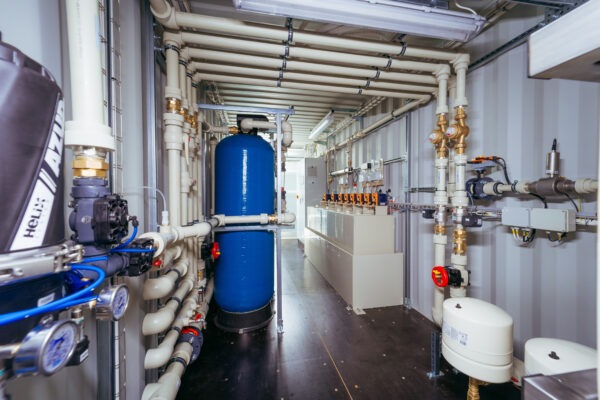
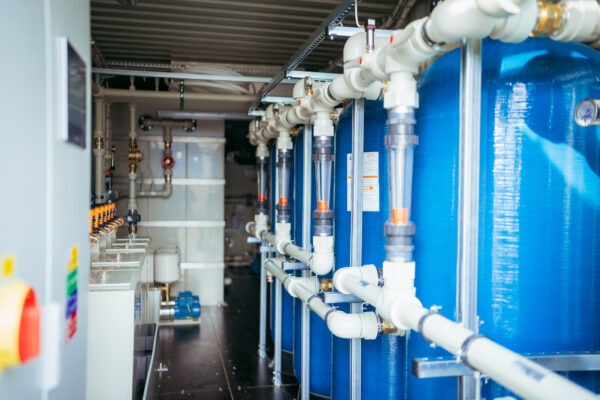
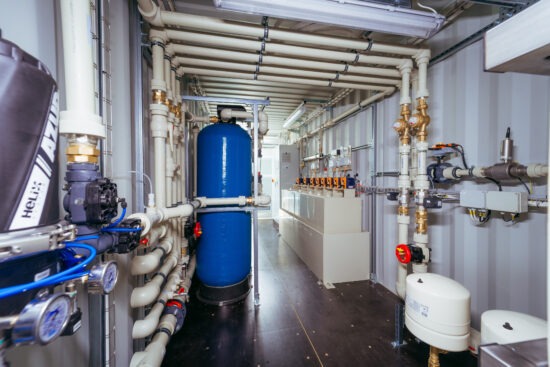
- Multi-stage non-pressure filtration using specialized filter media (BIRM, zeolite, activated carbon)
- Removal of mechanical impurities
- UV disinfection
- Water storage in a flexible storage tank
- Automatic pressure boosting station for distribution
- WaterBot water dispensing point
- Off-grid photovoltaic power supply with battery storage (48 V LiFePO4)
Technical Parametres
| PARAMETER | VALUE |
| Maximum water output | 2 000 l/h |
| Maximum daily production | approx. 40 m3 |
| Operating time | up to 20 hours per day |
| Container | 10 ft HC ISO – L 2,991 × W 2,438 × H 2,896 mm |
| Total weight | approx. 2 t |
| Outlet pressure | 1 bar |
| Installed electrical power | 1.2 kW |
| Population supplied (5l/person/day) | approx. 8,000 persons |
Water treatment process
Raw water is supplied from a borehole to the filtration section, where progressive multi-stage filtration removes iron, manganese, ammonium ions, organic substances, pesticides, VOCs and odours. Filter media are arranged in layers: gravel (4–8 mm) for water distribution at the bottom, filter sand (1–2 mm) as support layer, and active filtration media (BIRM, zeolite, activated carbon) as the main treatment stages. Filters are non-pressurized, gravity-driven units with open water surface and bottom inflow. After filtration, the water is hygienically secured by UV lamp and stored in a flexible storage tank. An automatic pressure boosting station ensures stable water supply to the distribution system and WaterBot dispensing point. Filter backwashing is performed by increasing the flow rate to 1.5–2x the operating flow rate. After opening the drain valve downstream of the tank, water is discharged to waste. The frequency and procedure of filter backwashing are described in the operating manual of the technology.
Automation & control
The technology is controlled by a dedicated electrical control panel. The system includes operational flow and pressure measurements, and sampling valves are installed for water quality monitoring.
Off-grid power supply
The unit is powered by an integrated photovoltaic system (6 kWp, 10 panels × 600 Wp) with 20 kWh LiFePO4 battery storage (48 V), Victron Quattro inverter/charger, and SmartSolar MPPT controller. This provides fully autonomous operation including night-time operation and operational reserve. A backup power source (generator) can be easily integrated if required.
The WaterCat 2000 S unit can be operated as a fully off-grid solution, making it suitable for deployment in remote locations without access to the electrical grid.
The system is designed to be powered by an integrated photovoltaic power supply with battery storage, providing autonomous operation under typical climatic conditions.
The energy concept covers continuous daily operation of the treatment technology, including night-time operation, while maintaining sufficient operational reserve.
A 48 V low-voltage architecture is used, selected for its robustness, modularity, and suitability for demanding off-grid applications. The power system allows easy integration of monitoring, protection, and optional backup power sources (e.g. generator) if required by site conditions.
The off-grid energy solution is optimized for:
- Reliable autonomous operation
- High system efficiency and low operational complexity
- Suitability for harsh environmental conditions
- Simple serviceability and scalability
Final configuration of the power system may be adapted to local solar conditions, operating regime, and project-specific requirements.
RANGE OF TREATABLE CONTAMINANTION
| Parameter / Substance | Max. permissible limit in raw water | Unit |
| Iron (Fe) | < 1 | mg/l |
| Manganese (Mn) | < 1 | mg/l |
| Hardness | unlimited | / |
| Ammonium ions (NH4+) | < 3 | mg/l |
| Pesticides | < 10 | µg/l |
| Turbidity (NTU) | < 2 | NTU |
| Total suspended solids (TSS) | < 20 | mg/l |
| Bacteria and viruses | all | / |
| Organic substances |
< 1 | mg/l |
Write to us
We wouldn’t be here without you. If you have any questions or feedback, don’t hesitate to get in touch.